BLOG
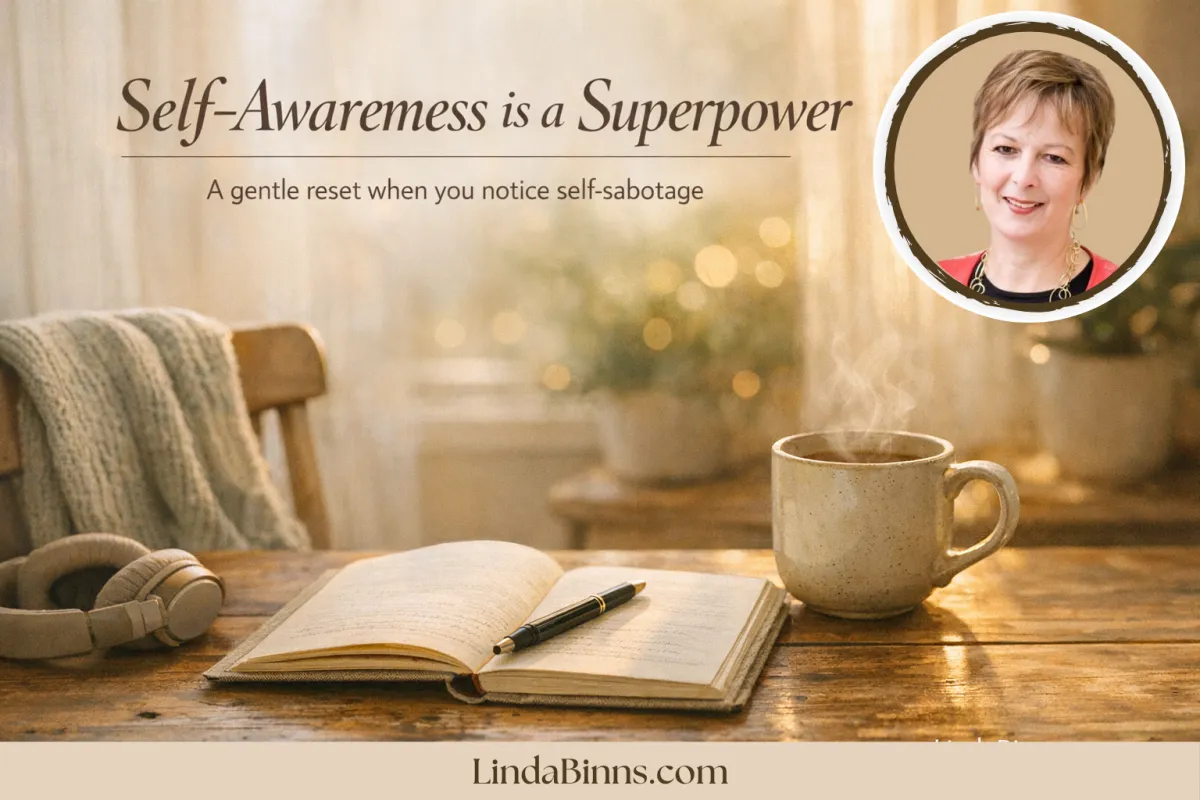
Self-Awareness: The Quiet Superpower That Turns Survival Into Thriving
Self-Awareness: The Quiet Superpower That Turns Survival Into Thriving
Introduction
I recently had a heartfelt conversation with Dr. Carla Marie Manly on her Imperfect Love podcast—about self-sabotage, imposter syndrome, and the quiet power of self-awareness. (If you’d like her beautiful write-up of our episode, you can read it here: https://www.drcarlamanly.com/discover-freedom-and-joy-with-the-superpower-of-self-awareness

One listener’s question stayed with me:
“Can you offer pointers for getting out of self-defeating habits? I procrastinate, then I feel bad about myself, and it spirals.”
If you’ve lived that loop, I want you to hear this gently: you’re not broken. You may be operating from survival energy—and survival energy is persuasive. It can sound like urgency, pressure, and self-criticism… even when you’re doing your best.
When survival energy is running the day, breath is fast and shallow, the body feels braced, and the mind starts trying to “prove” worth.
Self-awareness is the switch that begins to change it.
What Survival Energy Feels Like (And Why It’s So Exhausting)
Survival energy tends to be driven by fear, stress, obligation, or the need to please. For highly sensitive, empathic professionals, it can be even more intense—because you feel everything and you care deeply.
A few common signs:
• You wake up already behind (even when nothing has happened yet).
• You overthink, second-guess, or try to control outcomes.
• You feel responsible for other people’s emotions.
• You push harder… then feel depleted.
• You’re “functioning,” but not feeling much joy.
And here’s the part that surprises many people:
Sometimes procrastination isn’t laziness—it’s information.
It can be the nervous system saying, “This doesn’t feel safe.”
Or the deeper self saying, “This isn’t aligned.”
The “Thermostat” Pattern Behind Self-Sabotage
One way I describe self-sabotage is like a thermostat set-point.
As we grow up, we often internalize unconscious limits:
• “This is how successful I’m allowed to be.”
• “This is how visible I can be.”
• “This is how happy I get to feel.”
When your life starts rising above that old set-point, a protective part of you can kick in—not because it wants you to fail, but because it learned that staying small kept you safe.
So the sabotage can show up as:
• sudden “emergencies” that derail progress
• perfectionism that delays finishing
• comparison that drains confidence
• over-helping others until your own goals disappear
The goal isn’t to fight these parts.
The goal is to notice them… and choose something kinder.

A Simple Self-Awareness Practice: Notice → Name → Choose
When someone is stuck in the loop of self-defeating habits, I start simple. No gimmicks. Just a repeatable, human process.
1) Notice (90 seconds)
Pause and ask:
• What am I feeling right now?
• Where do I feel it in my body?
• What just shifted?
This isn’t about “fixing.” It’s about getting honest—gently.
2) Name the Pattern Without Shame
Try this language:
• “This feels like my inner critic.”
• “This feels like comparison.”
• “This feels like people-pleasing.”
• “This feels like my safety set-point.”
Naming creates space. Space creates choice.
3) Choose One Small Loving Step
I often ask: What’s one small loving step I can take for myself—today?
Not ten steps. Not a full reinvention. One.
A few examples:
• Send the one email you’ve been avoiding.
• Set a 10-minute timer and do a “first domino” task.
• Say no to one draining request.
• Step outside for 3 minutes and let your nervous system exhale.
• Clear one calm surface in your environment (Tiny environmental shifts often lead to a greater sense of inner ease.)
When you care deeply you can easily overdo it without noticing. This is why “small and loving” works—it keeps you connected to yourself.
Morning • Midday • Evening: Three Tiny Shifts That Change the Day
These are simple enough to dismiss—and powerful enough to shift your life over time.
Morning (30 seconds): Set the tone
Before you pick up your phone, try:
• “I am enough as I am.”
• “Today, I choose to move with kindness.”
• “I can take one aligned step.”
Midday (10 seconds): The check-in
Ask:
• “Am I in survival… or thriving?”
• “What do I need right now—space, water, a boundary, a breath?”
Evening (20 minutes): downshift
A gentle close to the day can change tomorrow.
Try: 20-minute self-care — stretch, breathe, dim the lights.
If your mind is busy, write everything out onto paper—no perfect journaling required.

A Self-Awareness Question That Changes Everything
If you take one thing from this, let it be this question:
What am I tolerating that’s keeping me in survival energy?
Sometimes we tolerate:
• an environment that drains us
• a role that no longer fits
• a relationship dynamic that costs too much
• expectations we’d never place on someone we love
Just because you can tolerate something doesn’t mean it’s right for you.
And you don’t have to wait until everything falls apart to make a change.
You can start now—one small loving step at a time.
Invitation
If you’d like a gentle weekly nudge to stay connected to your energy (and your self-awareness), you’re welcome to join my free Weekly Unstoppable Energy Tips here:
https://lindabinns.com/tips-home
More resources (optional)
• Take the 2-minute “Good Enough?” Quiz: https://api.leadconnectorhq.com/widget/quiz/yhVfXH83yN2Au9dj7zD3



Linda Binns
The Breakthrough Energy Expert
© 2023 | Privacy Policy
Facebook
Instagram
LinkedIn
Youtube