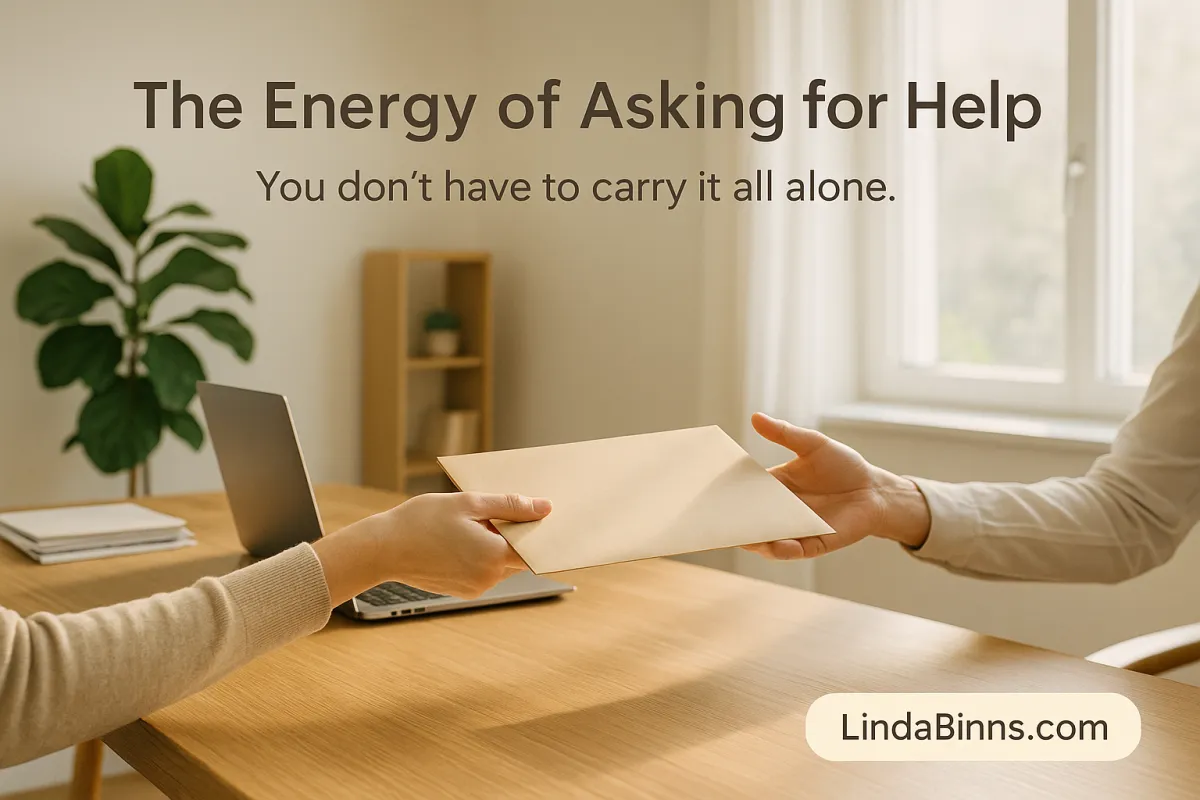
The Energy of Asking for Help: Why It’s Not “Being a Burden”
The Energy of Asking for Help: Why It’s Not “Being a Burden”
You might think that asking for help is simple.
Yet for many highly sensitive, caring professionals, it can feel like the hardest thing in the world.
You may recognize yourself here: you’d rather carry something that’s too heavy, push through one more task, or quietly struggle with a project than risk “bothering” anyone. You don’t want to be seen as needy or as someone who takes advantage of others.
I used to feel this way too. I once carried a very large piece of computer equipment across an office when someone finally asked, “Why don’t you ask for help with that?” It honestly hadn’t even occurred to me. My automatic setting was: I’ll handle it myself.
Over time, I came to see that this pattern isn’t just about being considerate.
It’s about energy, self-worth, and how open we are to receiving.

Why Asking Feels So Hard (Especially for HSPs)
Highly sensitive people often grow up feeling responsible for everyone’s feelings and comfort. We notice what others need long before they ask, and we quietly step in.
When this goes on for years, a few deep beliefs can form:
• “I should be able to handle everything myself.”
• “If I ask, they’ll think I’m weak or taking advantage.”
• “Other people’s needs matter more than mine.”
One of my dearest friends is one of the most generous people you could meet. She is constantly connecting people, supporting their businesses, and thinking of ways to help. Yet when she needs something herself, asking feels almost impossible. Even when I simply wanted to pay for her lunch, it was very hard for her to receive it.
What I’ve seen again and again is this:
Often, the people who struggle most to ask for help are the ones who give the most.
The “Arrogance” of Doing It All Yourself
A turning point for me came when a friend gently said something surprising:
“When you refuse help, it’s actually a little arrogant. You’re not letting people grow by helping you.”
I certainly wasn’t trying to be arrogant, but she was right.
By insisting on doing everything myself, I was silently sending the message:
“I don’t need you. I’m the only one who can do this properly.”
I was also denying others the opportunity to be generous, to serve, and to grow. Helping someone is often deeply fulfilling. Think about how you feel when you’re able to be there for someone you care about.
When we never ask, we close that door.
Asking as an Energetic Practice, Not a Weakness
From an energy perspective, asking is about allowing flow.
• When you never ask, your energy says: “I have to carry everything.”
• When you gently ask, your energy says: “I am open to being supported.”
This subtle shift affects everything: your nervous system, your health, your relationships, and your capacity to do the work you’re here to do.
You might begin with very small experiments:
• Let someone hold the door instead of rushing to hold it first.
• Say yes when a friend offers to bring something to a gathering.
• Ask a colleague for their input instead of trying to solve a problem alone.
These may seem like tiny actions, but energetically they are powerful. You are telling yourself: “My needs matter too. I’m allowed to receive.”

Helpful People: Inviting Support Into Your Environment
From a Feng Shui perspective, there is an area of your home or office called Helpful People. It’s in the front right area when you stand at the front door looking in.
This area relates to:
• Supportive mentors and colleagues
• Clients who appreciate your work
• Friends and community who show up when you need them
You don’t have to do anything complicated here. Simple adjustments can help:
• Clear clutter from that corner or wall so energy can move.
• Place something that symbolizes support for you (a photo of a mentor, a small statue, an inspiring quote).
• Set a clear intention as you tidy: “I am willing to ask for and receive the help I need.”
Tiny environmental shifts often lead to a greater sense of inner ease. When your space reflects “I’m supported,” it becomes easier to act that way.
A Gentle Experiment: Allow Someone to Help You Today
If you tend to be the strong one, the capable one, the one who “has it all together,” this might feel uncomfortable at first. That’s okay.
You don’t have to start with something big. Choose one of these gentle experiments:
• Ask for input on a project instead of trying to perfect it alone.
• Let someone treat you (to coffee, to lunch) and simply say, “Thank you, I appreciate this.”
• Share a small struggle with a trusted person and say, “I’d love your perspective.”
Notice what happens in your body as you do this. Does your breath become fast and shallow at first? Does your mind start worrying that you’re “too much”? Bring kindness to those reactions. They are just old protective patterns.
Over time, asking becomes less about “taking” and more about participating in a flow of giving and receiving.

Invitation: Explore Where “Not Good Enough” May Be Hiding
For many sensitive professionals, the difficulty in asking isn’t really about time or inconvenience. It often traces back to a deeper belief: “I’m not good enough,” or “I don’t deserve help unless I’ve earned it.”
If you’re curious about where this pattern might be operating in your life, I’ve created a short, free quiz to help you see it more clearly.
🌟 Take the 2-minute Imposter Syndrome / “Good Enough?” Quiz
It will help you identify the subtle ways self-doubt and over-responsibility are draining your energy and how you can begin to shift that.
👉 You’ll find the quiz link alongside this article on my website.
Reflection for You
As you move through the week, I invite you to gently notice:
Where are you still trying to carry everything alone, and what is one small, safe way you could practice asking for support?
You’re not meant to do life – or your work – by yourself.
Allowing yourself to ask is not weakness. It’s a profound act of self-respect and energetic alignment.