How Can I Make This Work for Me? The Question That Built a Business
How Can I Make This Work for Me? The Question That Built a Business
When I created this interview series, I wanted to go beneath the success. Not the strategies, or the credentials — the real human story. The moments that actually shaped someone. The decisions made not from confidence, but from necessity. The places where a person had to choose themselves, even when that felt terrifying.
My conversation with Dottie Scott gave me all of that.
Dottie is the founder of Premium Websites and the Ask Dottie series — a web designer, speaker, trainer, and best-selling author who has spent nearly two decades helping small business owners claim their space online. She’s known for making the complex world of digital marketing feel accessible, even joyful.
But before all of that, there was a young woman who didn’t know the word introvert existed. Who had a camera and a dream that didn’t quite fit. Who ended up building something from nothing — not because she had a grand plan, but because she had no other direction to go.
A Creative Who Loved the Solitude
Dottie’s path to websites started somewhere unexpected: photography.
As a teenager, she fell in love with it. Landscapes, trees, flowers, the quiet act of seeing something and capturing it. She went to the Art Institute of Seattle and graduated from their photography program, then went to work as a photo assistant for a portrait studio that also did weddings.
It didn’t last long.
“I was immediately introduced to bridezillas,” she told me — though she clarified it was really the mothers of the brides. “I realized I did not want to deal with this. I take great photos. Not dealing with the people.”
At roughly the same time, she began losing her vision. Critical focus became impossible, and autofocus technology wasn’t yet reliable enough to compensate. Two things converged to close that door: the people, and her eyes.
She didn’t abandon the creativity. She carried it with her — the love of color, composition, visual thinking. What she left behind was the path that wasn’t hers.
For years after, she describes holding a ton of meaningless jobs. Work that led nowhere. Work that didn’t fit. And underneath all of it, the quiet knowledge that she was worth more than she was being paid — often literally half of what male colleagues earned for the same work.
“I wasn’t willing to swallow that,” she said simply.
The Moment That Changed Everything
The decision to start her own business wasn’t born from ambition in the traditional sense. It was born from watching her daughter.
Her daughter was in kindergarten. Even then, Dottie could see who she was becoming — athletic, social, magnetic. “People just collected around her, even in kindergarten.” Dottie wanted to be available for all of it. The games, the events, the things that happen in the middle of an ordinary Tuesday.
She decided to teach herself a skill that married the two things she loved: art and technology. Everyone else seemed to hate technology. She loved it. And websites were the place those two worlds met.
“I literally taught myself how to code a website by hand,” she told me, laughing. “Thank God that didn’t have to stay that way for very long.”
She started her business not as the only breadwinner, but with the intention of reinvesting what she made — building slowly, sustainably. And then her partner lost his job. And then he never really found stable work again.
“It was like putting your feet to the fire,” she said.
Overnight, her business needed to do something entirely different. It needed to support a family.
The Introvert Who Had to Learn to Show Up
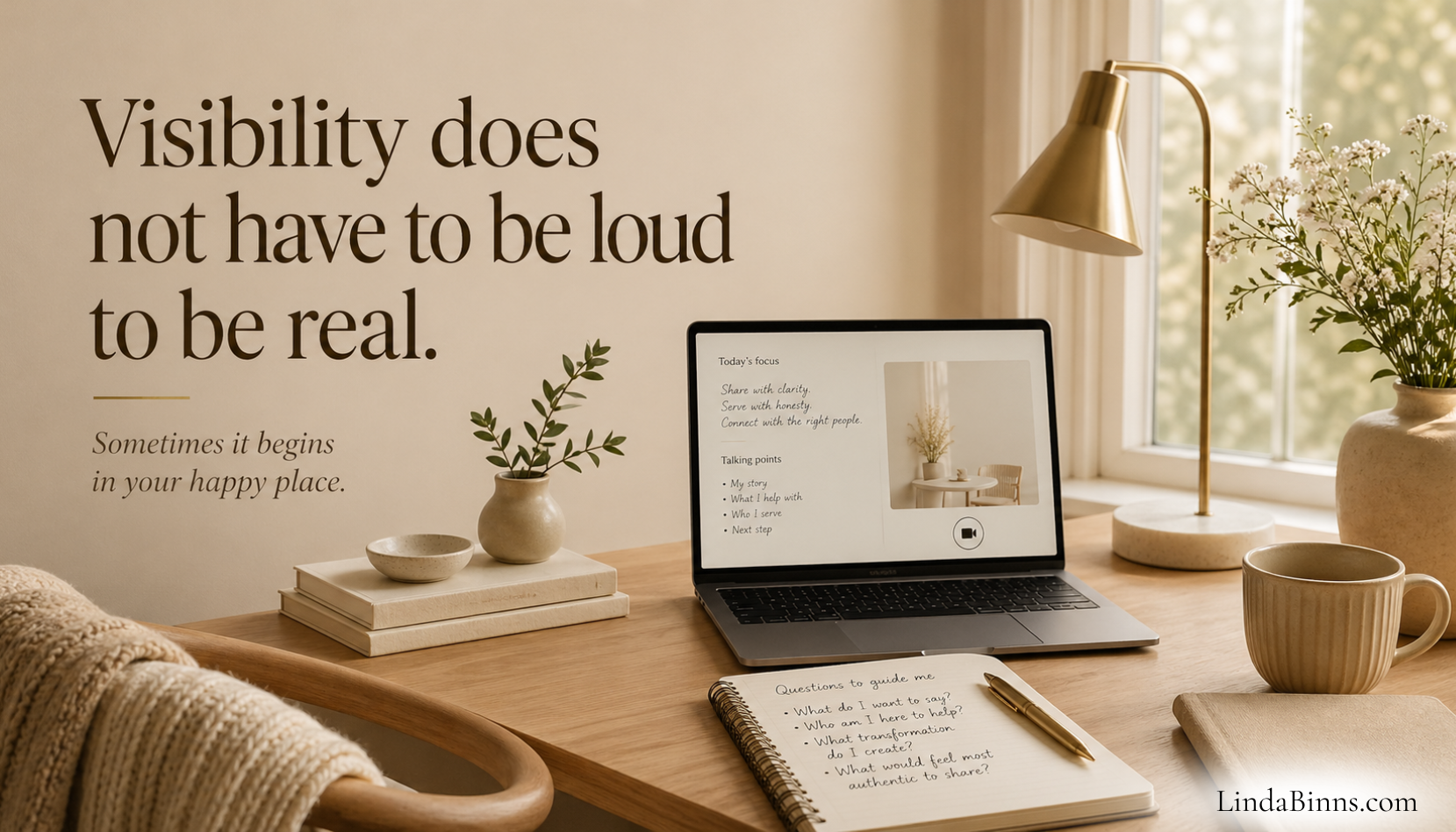
Here’s what makes this especially remarkable: Dottie is a true introvert. Her home office is her happy place. Networking events, big rooms full of strangers, being asked to speak — all of it was deeply uncomfortable.
“I was at about a zero,” she said, when I asked how comfortable she was with visibility at the start.
But with her feet to the fire, she had to figure out how to get clients. So, she did something that, looking back, was real genius — though she’ll be the first to tell you she was just trying to solve her own problem.
She started collecting questions. When people at networking events asked her about social media, she’d go home to her happy place, record a short video answer (30 to 45 seconds, one thing only) and send it out by email.
Her logic? “When someone asked that question again, I could just send them the video.”
What actually happened was something else entirely. People started seeing her in their inboxes, on Facebook, on LinkedIn. They’d approach her at events saying, “Dottie, you’re everywhere.”
She was in her office.
But even more than creating the impression of being everywhere, those videos solved something deeper. As an introvert, she’d always struggled to break into conversations at networking events — standing on the edges, watching circles of people she didn’t know how to approach. The videos changed that. People walked up to her, feeling like they already knew her. She could relax. The conversations flowed.
She attended two networking groups a day — morning and noon — because she was the only website designer in the whole organization and could attend any group at no extra cost. She became a guest speaker, despite never having wanted to be one. Her first time speaking to a room of twenty people felt, she said, like a “ginormous” number.
She created handouts for every presentation — ostensibly for the audience, so they could take notes. Really, they were something to hold onto. Something that told her where she was in her talk.
“I really did it for me, even though I made it look like I did it for them. That strategy worked for years and years and years.”
“I Could Only Look Forward”
When I asked what entrepreneurship had taught her about herself, she paused.
“It has really taught me how to stick to something,” she said. “Prior to this, I had a ton of meaningless jobs. I’ve had this business for twenty years. I haven’t even lived in the same house for twenty years.”
And underneath that: the realization that she could take care of herself. That she didn’t need anyone else to set the terms of what her work was worth.
She knew when she was being underpaid in those earlier jobs. She knew what she deserved. She just hadn’t yet had a way to claim it.
Building her own business gave her that. And when the moment came that she had to make it work — really work, no safety net, no one else bringing in income — she found out what she was made of.
“I could only look forward. That was the only direction that was viable.”
COVID, when it came, was almost a non-event for her. She was already working from home. Already comfortable alone. What it did was remove the commuting, the parking, the hours spent driving to in-person meetings. Her business grew. Her reach expanded from the Pacific Northwest to clients in almost every state.
She now considers herself 100% unemployable, and she says it not as a limitation, but as a fact she’s proud of.
The Takeaways
What stays with me most from this conversation is the portrait of a woman who kept finding her own way through.
·A teenager with a camera who loved the quiet of it.
·A young professional who couldn’t make someone else’s version of her work.
·A new mother who needed to be present for her daughter’s life.
·An introvert who built a presence online specifically so she didn’t have to be in the room.
At every turn, Dottie asked herself: how can I make this work for me? Not how can I become someone else, or muscle through, or follow the conventional path. How can I make this work for me.
That’s self-led leadership. And it’s been working for twenty years.
You can find Dottie Scott at premiumwebsites.net and askdottie.com, or connect with her on Facebook and LinkedIn.
If this conversation resonated with you, you can watch the full video here, and I’d love to hear what landed most. This is exactly why I created the Self-Led Leadership Interview Series — to explore the real experiences beneath the success, and the quiet ways we learn to trust ourselves along the way.